Repeatability of Ink Transfer and Color Management in Lithography
Saleh Abdel Motaal and Mohammed Sikander
Ryerson University
Published 2009
DownloadAbstract
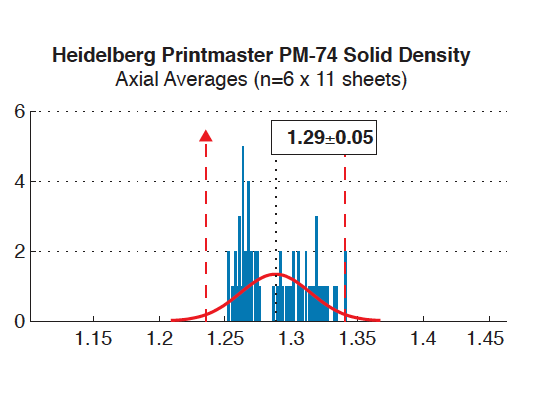
The purpose of this research is to investigate the applicability of color management to lithography printing by exploring repeatability of ink transfer and its implications on thresholds and tolerances specified by the ISO 12647-2 and specifications like GRACoL 7. Two presses were investigated, a Heidelberg Quickmaster DI-46 and a Printmaster PM-74, using a special test form divided into 9 and 18 regions, for each press, respectively, to look at repeatability on the circumferential and axial dimensions. Densitometry and colorimetry measures were both explored, with focus on solid values, and all based on spectrophotometric data generated. This report is a continuation to a previous study (Abdel Motaal & Sikander, March, 2008) and adds the new dimension of comparison of the newly produced Printmaster data to the previous DI-46 set.
The Quickmaster DI46 4-color direct imaging waterless press was tested as a variant of a common impression cylinder to explore the potential for achieving the tight specifications and tolerances. The Printmaster’s added width and conventional inking allows us to expand on the implications of circumferential and axial variations on the application of color management practices.
Based on a sample-set of 11 sheets from 100 consecutive good prints, we conclude that each press has unique ink transfer repeatability patterns that would impact the effectiveness and accuracy of color management at the calibration stage and during production. The Printmaster was susceptible to higher CIE L*a*b* variation values, as defined in the ISO 12647-2, with up to ΔEab of 5.44 in the CMY 3 color black patch. The DI press had more stable variability results yet has failed to meet the deviation tolerances for some primary colors and a number of secondary overprints.