High-Resolution Analysis of Optical and Physical Dot Gain
Mahziar Namedanian and Sasan Gooran
Linköping University
Published 2010
DownloadAbstract
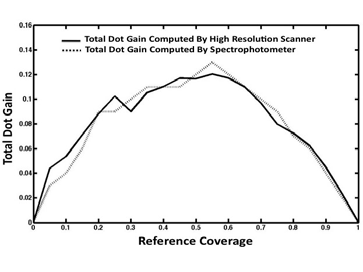
The printed dots appear bigger than the dots in the original digital bitmap. This is partly because of the spreading and penetrating of the ink on and in the paper, called physical dot gain, and partly because of the diffusion of the light in paper, which is referred to as optical dot gain. Dot gain is often approximated by measurements obtained by densitometer or spectrophotometer. In this study we use a very high-resolution scanner with a resolution of 2 μm/pixel and with a field of view of 2.7×2 mm, which makes it possible to clearly see the small halftone dots and their surroundings. In this camera it is also possible to illuminate the paper surface both from above and below, which means that the camera can capture both the reflected and transmitted lights. Since the transmitted light does not scatter in paper, the optical dot gain has no effect on the transmitted image. In this paper we investigate the behavior of physical and optical dot gain for print on coated paper in offset, by using the micro-scale images. We also present a method to separate optical and physical dot gain by using the reflected and the transmitted images. By comparing the reflectance and transmittance histograms it is possible to understand that there is no optical dot gain in transmitted image. We also compare our results with the result obtained by a spectrophotometer, which also measures both reflected and transmitted light. Previously the physical and optical dot gains were mostly analyzed numerically; however, in this paper we will also graphically illustrate and compare these two concepts by using micro-scale images.