Categorical Effects In Printed Color for Elderly and Young People Under Different Color Temperature of Lighting
Supawadee Theerathammakorn 1 and Boonchai Waleetorncheepsawat 1; Tomoko Obama 2
1 Sukohthai Thammathirat Open University; 2 Shizuoka University of Art and Culture
Published 2019
DownloadAbstract
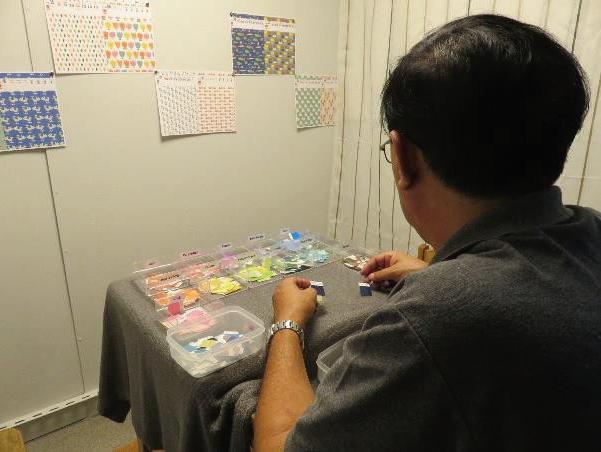
This study focused on printed color chips based on 12 categorical colors by elderly and young people under the difference in color temperature of lighting. The experimental subjects were comprised of 15 elderlies with the age of 60 – 70 years old and 30 young people with the age of 25 – 35 years. The subjects determined the printed color of 1,046 color patches and sorted them out into 12 category color boxes (Red, Red-Yellow, Yellow, Yellow-Green, Green, Green-Blue, Blue, Blue-Purple, Purple, Purple-Red, Pink and Brown). In case of no decision on color patch into the 12 color boxes, the patch was put into “Out” box. The viewing conditions were LED lamp with 2 correlated color temperatures (CCTs) of 6500 and 2700 K, with illuminance of 700 lux, and 0/45 degree observer. CIELAB, CIELCH color space of color patches, and color difference from reference color were evaluated and MANOVA was also applied in terms of statistical analysis. In addition, the 12 categorical colors perceived by the two groups were evaluated by using color difference (∆Eab and ∆E00). The results revealed that the categorical colors affected on CIE L*a*b* significantly whereas group age and lighting condition had no significant difference. In addition, the categorical colors of elderly under 2700 K presented remarkable color difference compared to elderly under 6500 K, young under 6500 K and 2700 K. The findings suggested that the interaction between color categories and different groups of aging people and also using color design under different lighting condition should be considered.