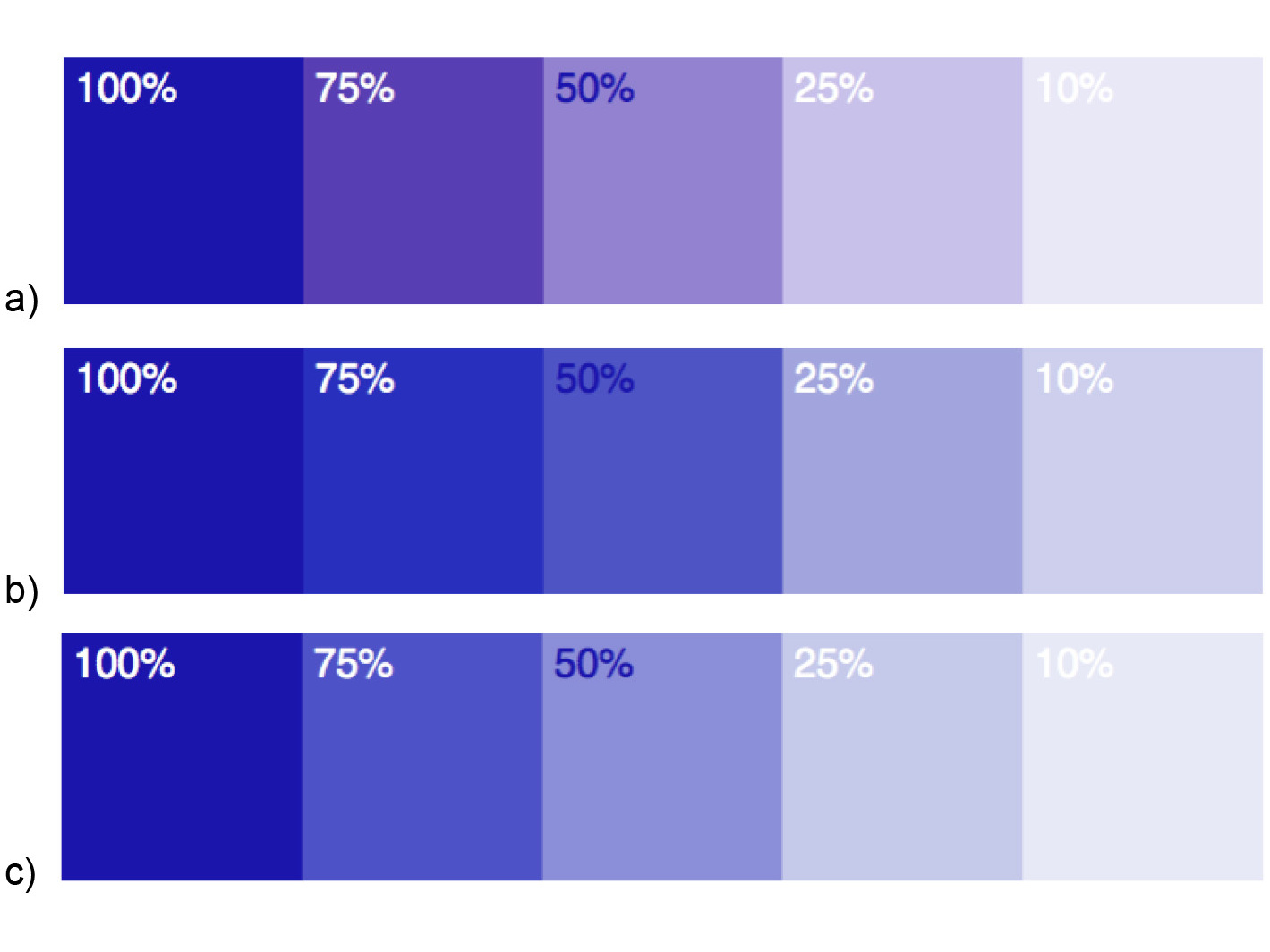
Evaluating Hue Shifts in Spot Color Tints
Himanshu Rana
Clemson University, Dusty Rhodes Graduate Student Paper Award
Published 2020
DownloadAbstract
Packaging plays an important role in the modern world. It helps to preserve, protect, dispense, communicate and sell a product. Printing and color are key components of the communication and selling functions. Printing can broadly be classified into two categories on the basis combination of inks being used – process and spot color printing. Process color printing involves use of combinations of process colors – Cyan, Magenta, Yellow and Black (CMYK). Expanded gamut printing is a special case of process printing where additional colors, typically orange, green and violet, are used to achieve a larger color gamut. Spot color printing uses specially formulated inks that are designed to achieve a particular color appearance on a given substrate. The brand colors as commonly printed as spot colors. Different brands use characteristic colors that the consumers can relate to their products and brand identity e.g. a coca cola red or a Pepsi blue. Color can be defined using colorimetric coordinates in a 3-Dimensional (3D) CIELAB space. The L* represents lightness or darkness, a* stands for redness or greenness and b* indicates the yellowness or blueness of a color. These colorimetric coordinates can also be represented in CIELCH space using L*C*ho values, where C* is the chromaticity and ho represents the hue angle of a color. The Studies have suggested a higher visual sensitivity towards hue as compared to saturation and lightness (Danilova & Mollon, 2016) (Durmus & Davis, 2019).
The study was limited to six spot colors on a single paperboard packaging substrate. The study was conducted with water-based inks as these are common for paperboard packaging. Pantone-Live dependent library Flexo Water-Based Coated Paper (FWCP) was used as a digital reference. Other software solutions, although available, were not evaluated under this study. The substrate was chosen based on substrate in the Pantone-Live FWCP library.