Breaking the Pigment-to-Binder Ratio Paradigm of Metallic Pigments: Concomitantly Promoting Pigment-Binder Bonding and Metallic Pigment Orientation
Christopher Hilbrich and Devin Schmitt
ECKART America Corporation
Published 2021
DownloadAbstract
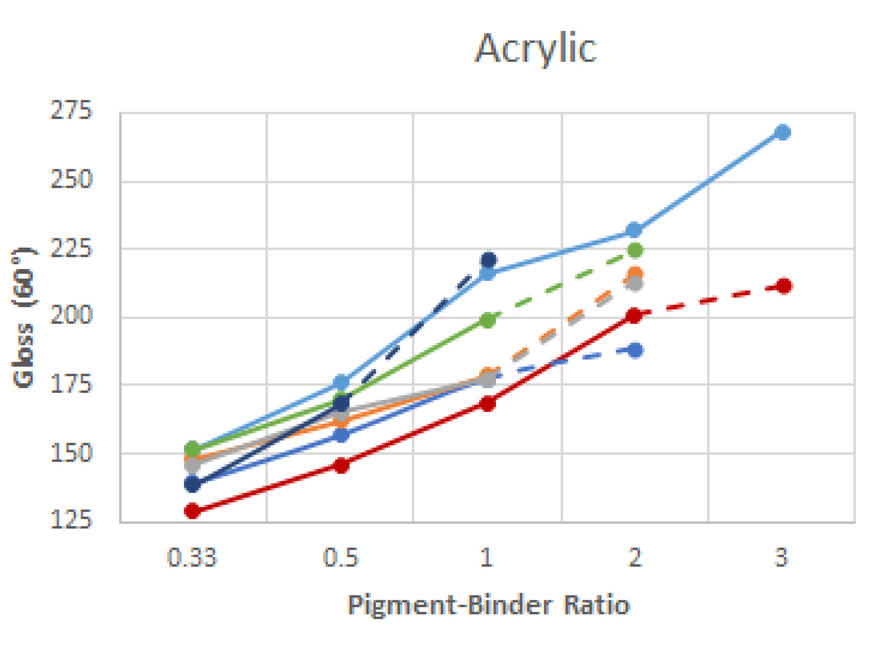
Aluminum PVD (Physical Vapor Deposition) effect pigments afford highly reflective surfaces, combined with large surface area, resulting in excellent optical performance in many applications with low binder content. In applications requiring high mechanical performance, higher binder content is typically utilized out of necessity, resulting in degraded optical characteristics (gloss, clarity, etc.). Good mechanical performance in high binder systems is a result of strong binder cohesion and increased binder intercalation. Pigment orientation is also paramount to improving optical characteristics. Our focus is a modification of the PVD pigment to promote both orientation and strong pigment-binder bonding, effectively reducing the necessity for binder intercalation. This allows for the use of a higher pigment-to-binder ratio, improving optical characteristics while maintaining good mechanical performance. We show that pigments can be uniquely modified per binder system class (urethanes, acrylics, etc.) to provide their best optical and mechanical performance.