A New Light Source for Photostability Testing Shows Promising Results
Sean Fowler, Andy Francis, Bill Tobin and David Duecker
Q-Lab Corporation
Published 2025
DownloadAbstract
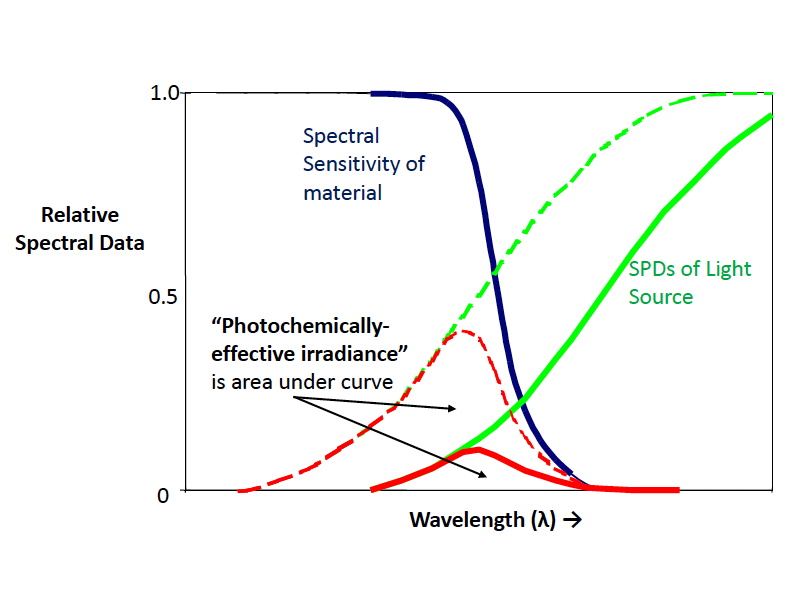
Photostability testing of printing inks and media is an important element for image permanence research and quality control. Dating back several decades through ASTM and ISO standards, testing has typically been performed in xenon arc test chambers, due to the broad spectral output of xenon arc lamps, which can be optically filtered to match direct sunlight or exposures through window glass in the UV, visible, and infrared regions. However, most of the spectral output from xenon arc lamps has little bearing on photo-oxidation of printing inks due to insufficient photonic energy to break chemical bonds. These wavelengths in the visible and infrared spectral regions provide radiant heat to specimens under test, which must be removed by active cooling measures in many cases to prevent unrealistic thermal effects. The complexity of operating xenon arc chambers and removing unwanted heat increases the cost of testing, but nonetheless these chambers have been the best technical option for photostability testing for a long time.
Another photostability technology has been available and used by other industries for more than 50 years: fluorescent UV weathering chambers including moisture. Popular in the coatings and plastics industries, fluorescent UV chambers are less commonly used in the graphic arts field due to a lack of well-suited lamps for the application. Users had to choose between accurate simulation of the sunlight spectrum in just the shortest wavelengths (UVA-340 lamps) or an indoor light source with very little UV output (cool white lamps). It wasn’t possible to get both in the same exposure like a xenon arc chamber provides. However, a new fluorescent light source promises to eliminate this disadvantage and deliver fast, realistic tests at reduced cost. This light source matches the spectrum of sunlight from the solar UV cut-on wavelength into the blue-violet portion of the spectrum.
In this study, test prints were obtained from a commercial photographic printing service and exposed in a xenon arc chamber, a fluorescent UV chamber with standard UVA-340 lamps, and in a fluorescent UV chamber with a new lamp type, called TUV-421 lamps. In order to reduce complexity, tests were performed without any water spray or condensing humidity. Specimens were evaluated visually and by color spectrophotometry. Initial test data shows that this light source causes realistic fading of photographic printing inks and may be a good option for photostability testing due to its low cost and simple operation.