Understanding Fluorescence – Measurement, Simulation and Correction
Max Derhak
Onyx Graphics
Published 2025
DownloadAbstract
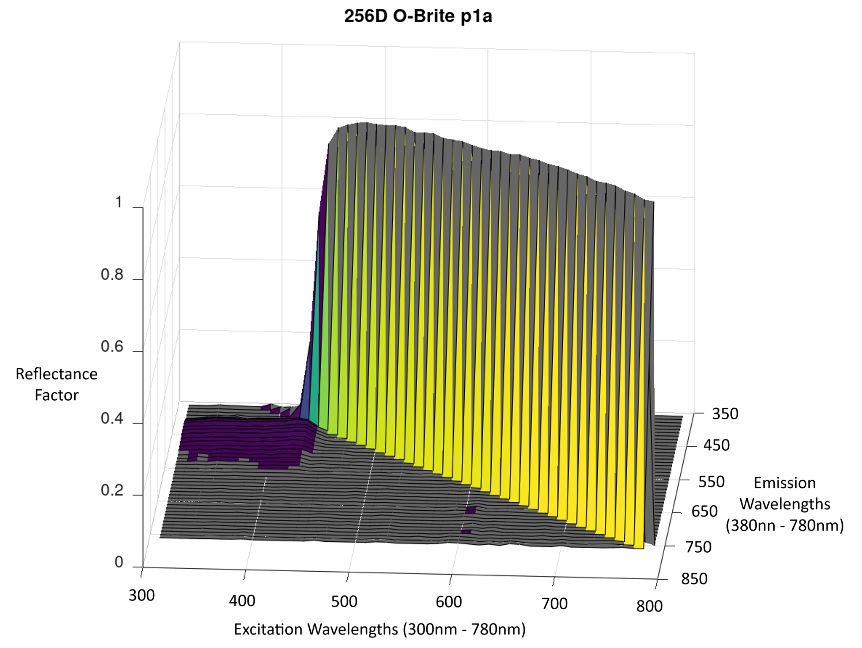
Optical brighteners are often used to make yellowish paper or media appear whiter and brighter, resulting in a product that is much more appealing. The operative aspect of optical brighteners is that they use fluorescence to convert ultraviolet light (which is invisible to human vision) to blue light (which is visible). The amount of fluorescence is related to the light in the ultraviolet portion of the spectrum and changes under different light sources. However, this poses problems for establishing color management profiles using a spectrophotometer to measure spectral reflectance to derive colorimetry of printed colors under arbitrary light sources on media. The challenge is that the derived colorimetry doesn’t match the actual color appearance, resulting in undesirable color casts in the final printed output using color management.
In this paper, a comparison of measuring spectral reflectance versus measuring spectral fluorescence will be reviewed along with the mathematical differences related to spectral reflectance and spectral fluorescence. It is shown that colorimetric measurements derived from spectral reflectances of surfaces that have fluorescence are only valid for the light source used in the spectrophotometer to measure the spectral reflectances. This is because the application of a light source to spectral reflectance to predict the light reflected off the surface doesn’t consider the hidden fluorescence when the spectral reflectance measurement was made.
A method of simulating spectral fluorescent measurements is proposed based on an extension of the adjustment used in Substrate Colorimetric Correction Aims (SCCA) by first applying the approach to spectral reflectance and then spectral fluorescence. A simple physical model related to fluorescent substrate correction is presented. Having the ability to use simulated measurements eliminates the need to use expensive measurement equipment to get spectral fluorescent measurements for the purposes of evaluating the extent of divergence and error when using spectral reflectance measurements of colors on media with optical brighteners.
A set of spectral fluorescent measurements were then estimated using this proposed method of deriving spectral fluorescent measurements as part of a virtual experiment for colors of an IT8.7/4 chart on a hypothetical media with an optical brightener with significant fluorescence. Corresponding spectral reflectance measurements were then derived from this set using a virtual spectrophotometer with various embedded light sources. This enabled comparisons to be made between the resulting spectral reflectances and their predicted colorimetry to gain insight into the extent of colorimetric shifting between applying different light sources/illuminants to reflectances having fluorescence (measured with different embedded light sources). Reporting, observations, and recommendations from this virtual experiment are then made. One conclusion from this virtual experiment is that colorimetry for spectral reflectances (that involve fluorescence) under a desired light source/illuminant is only correct for the light source that was used in the spectrophotometer to make the measurement. Repurposing spectral reflectances to other light sources/illuminants results in errors in predicting the color appearance.
One question that resulted from this experiment was whether some form of correction could be applied to spectral reflectance measurements to better predict the colorimetry (and actual color appearance) for a different light source than the one that was used to make the measurement. An approach was tried using the set of estimated spectral fluorescent measurements to derive such a correction. This correction doesn’t exactly predict the colorimetric results using spectral fluorescent measurements. However, it does provide improved prediction with less colorimetric error. There is one challenge with this approach in that it requires a correct understanding of the fluorescent behavior of the media.
Future research efforts could involve finding correlations with measurements to spectral fluorescent media modeling to allow for corrections to be applied to actual spectral reflectance measurements to get better prediction of color appearance with fluorescence under arbitrary light sources.