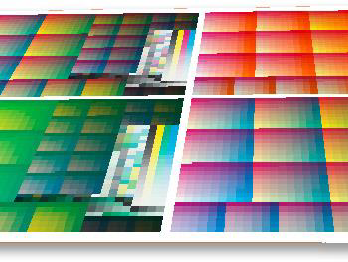
Efficient and Accurate Color Conversions for Multicolor Printing
Dr. Hanno Hoffstadt
GMG Germany
Published 2026
DownloadAbstract
This paper addresses the challenge of accurate color conversion in multicolor printing, where conventional ICC table‑based methods become impractical due to exponential growth in table size. It introduces a subspace‑based data format and transformation engine that stores only key ink combinations while estimating missing combinations with controlled interpolation and correction stages. The approach supports high accuracy, reduced memory usage, and flexible conversion to Lab, spectral, or device color spaces—even when overprints involve more than four inks. The method enables scalable color management for expanded‑gamut and spot‑color workflows without the discontinuities or storage limits of earlier solutions.
Color conversions for printing are usually done with conversion tables which are stored in color profiles (like ICC profiles) and performed by a transformation engine. Tables are organized as a complete multi-dimensional grid which allows for fast interpolation. For CMYK printing, this is well established. For example, conversions from CMYK to CMYK often use tables with 17 steps per ink, which is enough resolution to sample the behavior of nonlinear processes. Such tables have 17⁴ entries. Each entry has 16-bit values per output channel, in this case 8 bytes, so that the complete table occupies 650 KB.
In multicolor printing, about 2–4 inks are typically used in addition to CMYK (custom spot colors or extra process colors). Customers expect the same accuracy for the CMYK part as before, which is a challenge due to the exponential size of the table grid. Even if only 10 steps are used for the additional inks, the number of entries increases by a factor of 10² to 10⁴, which takes too much memory and computation time.
Our goal was to find an approach for color conversions with small table sizes, high accuracy, support for many inks, and the ability to transform any input ink combination to Lab, spectra, or other device color spaces.
We achieved this goal with a new subspace-based data format and corresponding transformation engine. Only important ink combinations are stored, but as complete subspace tables with fast interpolation. The engine can estimate results for ink combinations which are not available. Different methods are available for Lab, spectral and device link values. To avoid uncontrolled extrapolation, correction stages can adjust estimations to known bounds.
Often, a color is separated with not more than 4 inks, and some combinations can be excluded. ECG printing with CMYKOGV inks might use only CMYK, OMYK, CGYK, and CMYV or CMVK. Therefore, earlier solutions relied on such separations for special cases and needed to store only a few 4-dimensional tables [1]. Later, an iccMAX example was given for CMYK using multiple 3-d tables and one two-step CMYK table [2]. However, the selection mechanism caused unwanted jumps at transitions from 3-d to CMYK.
Also, it cannot be guaranteed that input data for transformations are restricted to known subspaces. Resampling of image data and contour trapping can create areas with more than 4 inks. In proofing, registration marks occur typically in all inks. The transformation engine must provide a decent estimate of such overprints even though they are not stored in a table.
Our storage concept uses an arbitrary collection of subspaces, where each ink has to occur at least in one subspace and must have the same table steps in all subspaces where it appears. For example, for a use case with CMYK+2 spot colors X and Z, we could have 3 tables: CMYK (4-d), X (1-d), Z (1-d). But if overprints with black are also known (like in the HKS 3000 swatch books), we could have CMYK, X+K (2-d), Z+K (2-d), where K must have the same steps in all three tables.
Our transformation engine examines the input ink values. The non-zero inks form the subspace of the input. If a table exists, the result is interpolated and returned as a authoritative answer. If not, an estimation must be calculated. Earlier methods required at least known corners of overprints [3], which are often not available (consider X and Z, where neither X+Z nor X+Z+CMYK is known).
So our transformation must be able to work without this information. Our estimation works by splitting the inks into two sets, one with a known result, and another (preferably with a low contribution) whose effect on the output values can be determined from a containing table. The estimator then applies the effect on the known result and returns it as an estimation.
For example, the effect of a percentage P of X could be determined from a containing table (1-d X, or 2-d X+K above) from the result with P and the result where P=0.
Our correction concept allows for multiple stages. The first stage has a set of subspace tables with high resolution (many steps per ink) but lower dimensionality. The optional following stages have a different set of subspace tables with lower resolution but higher dimensionality. If the transformation gets an authoritative answer at a stage, it stops. An estimated result can be taken to a next stage and be corrected according to an interpolation in those tables.
In this way we can use known n-dimensional corners, e. g. from our spectral prediction model, and adjust the estimation to predefined results.
The presentation will provide additional details and examples.