Evaluation of printability of screen- and pad printing inks via high-viscosity piezo inkjet technology
Antonia Götz
Hochschule der Medien
Published 2026
DownloadAbstract
Inkjet printing is not only interesting for graphical applications but also offers advantages for functional applications such as printed electronics, selective gluing, and medical uses. However, in these applications, the focus lies on the desired properties of the final print. In the case of dentures, for example, this may be a certain toughness, while for printed electronic structures, it is the ability to conduct electricity.
Currently, these applications are addressed by other printing or additive manufacturing techniques such as vat photopolymerization or screen printing. While these techniques offer a wide parameter range for materials, there are applications that require greater flexibility and individualization during processing or a multimaterial printing approach.
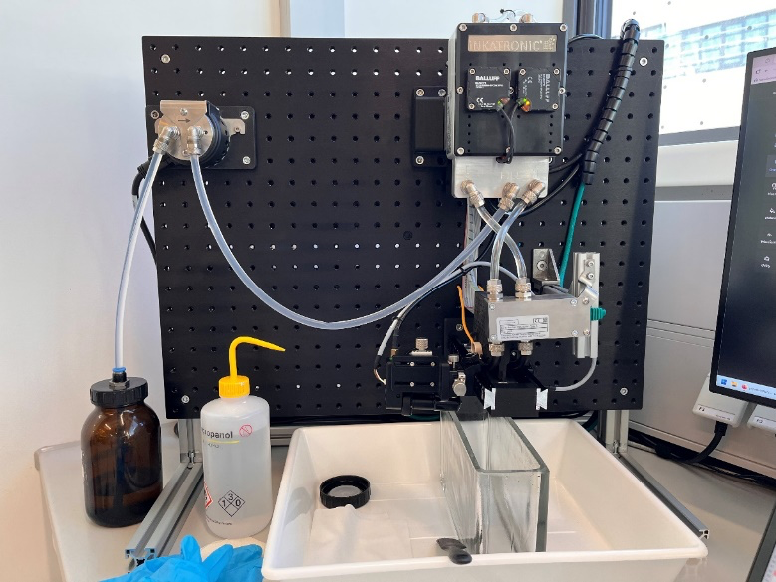
One printing technique that offers a high level of individualization, flexibility, and multimaterial capability is inkjet-based digital printing. It enables rapid on-demand production, requires no printing form, and is contactless. One disadvantage of inkjet printing, however, is its strong limitation in terms of jettable materials. The maximum viscosity for typical industrial piezo inkjet printheads is around 25 mPa∙s. Recently, however, a novel printhead technology developed by Quantica GmbH has been introduced, which can jet fluids with viscosities of up to 250 mPa∙s. This opens the possibility for a whole new range of functional fluids that could potentially be processed via inkjet.
However, the high particle loads and rheological behavior of functional materials are not yet well researched from an inkjet printing perspective. In this study, a systematic method to characterize these fluids is presented. This work presents the first steps toward identifying suitable characterization methods and potential materials to systematically evaluate the correlation between ink properties and waveform parameters.