Balancing Regulatory Compliance and Color Performance: The CMYKOV Ink Gamut for Direct Food Contact Offset Printing
Aileen Chiu
Sun Chemical Corporation
Published 2026
DownloadAbstract
Direct food contact printing plays a critical role in food packaging, where inks must comply with strict safety regulations to prevent contamination. These regulatory and formulation constraints significantly limit pigment selection, which in turn affects the achievable color gamut. For brand owners and printers, this creates a challenge: how to maintain color fidelity and visual appeal while ensuring consumer safety and sustainability.
In a prior study, we quantified the color capabilities of an ink set compliant with direct food contact requirements by mapping achievable PANTONE® Solid Coated colors within a tolerance of ΔE₀₀ < 2. This analysis identified 1,801 colors that could be reproduced, providing a baseline for understanding the limitations imposed by pigment restrictions. Building on this foundation, and with sustainability in mind, we explored whether an extended color gamut (ECG) workflow could achieve acceptable color reproduction under compliance constraints.
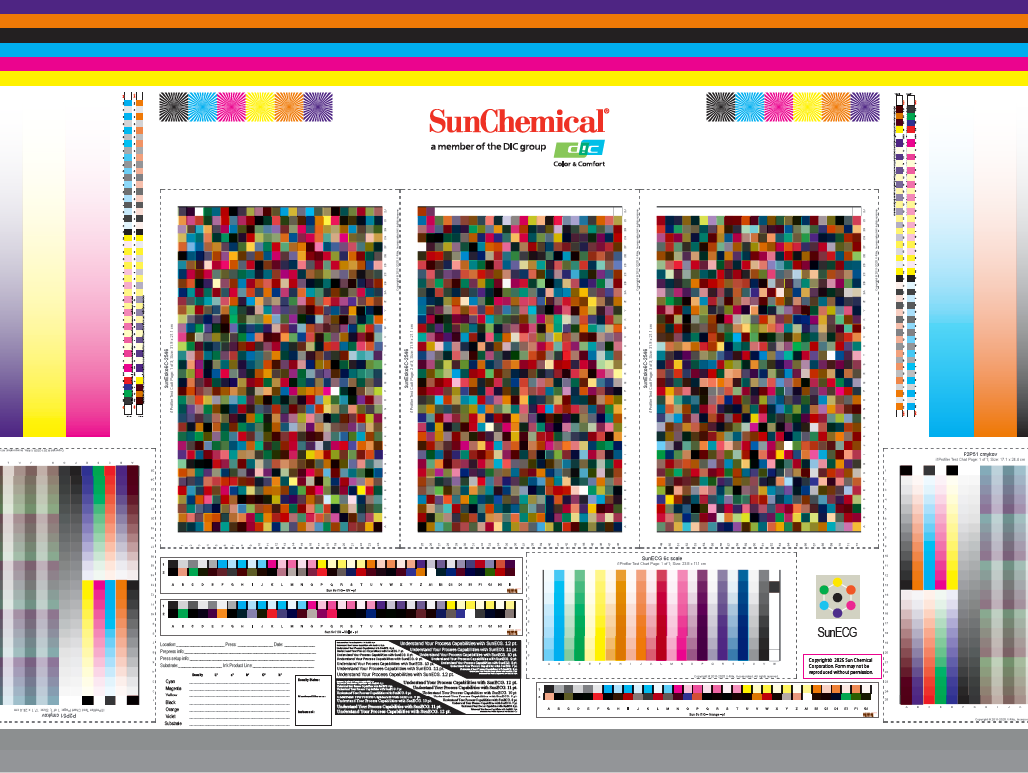
This paper evaluates a CMYKOV (Cyan, Magenta, Yellow, Black, Orange, and Violet) ink set formulated for direct food contact (DFC) applications in sheetfed printing. The ink set evaluated in this study was developed in accordance with European DFC regulatory requirements and may not be compliant with regulations in other regions. The study examines the ability of CMYKOV to extend the chromatic range relative to the characterized reference printing condition CRPC6 of ISO/PAS 15339, while acknowledging its limitations compared to the broader Pantone colors commonly used in packaging printing. Although the addition of orange and violet inks expands the gamut beyond conventional CMYK, regulatory pigment restrictions introduce significant challenges, including reduced vibrancy, hue shifts relative to standard CMYK process printing, and a noticeable color cast in neutral gray areas. In addition, the absence of established density specifications complicates process control.
The findings offer practical insights for color engineers, prepress specialists, and food packaging printers seeking to balance safety, sustainability, and color performance. By understanding the trade-offs involved in ECG workflows compliant with direct food contact requirements, stakeholders can make informed decisions about ink selection, color management strategies, and brand color expectations.